Make it fit everyday life.
Participants wanted to understand how smart charging would work around their routines. We proposed a lifestyle questionnaire and personalised explanations, rather than asking people to interpret generic information.
Industry brief · Student team project · May 2024

Helping future EV drivers feel confident about smart charging at home.

I was the client communications lead in a six-person student team. I acted as a point of contact for EDF, contributed to the team’s UX research and co-presented our final concept.
The research, wireframes and interface designs shown here are collaborative team work. Our proposal brought personalised guidance, educational content and community support into EDF’s website.
Client communications · Research contribution · Co-presentationHow could EDF encourage the next wave of EV users to engage with intelligent charging—and trust an energy company to manage charging in their interests? The team focused on people still researching an EV, before charging habits were established.
Participants wanted to understand how smart charging would work around their routines. We proposed a lifestyle questionnaire and personalised explanations, rather than asking people to interpret generic information.
Conflicting information and uncertainty about providers pointed towards clear educational content, verified answers and identifiable energy specialists.
Community discussions mattered, while app overload was a concern. The team placed the concept on the website, where people were already exploring their options.

The interviews and online review were exploratory research. They informed the concept; they were not a representative survey of all EV drivers.
Early directions explored discussions in the Pod Point app, gradual off-peak charging schedules, a video advert and a routine-focused landing page. Feedback raised concerns about reaching only existing users, making people feel controlled and oversimplifying the topic. The team used MoSCoW prioritisation to combine the strongest elements into a website journey.
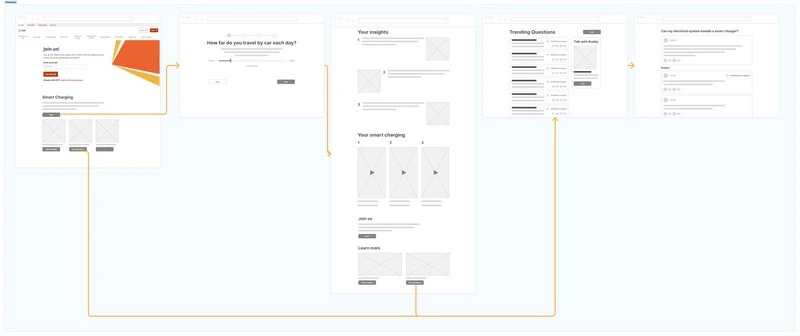
A connected path from initial research to tailored guidance, with human support when questions remain.
Introduce smart charging during the research phase and give visitors routes into personalised guidance, discussions and Buddy support.

Ask about travel and lifestyle to make the suitability of smart charging easier to understand. The questionnaire aims to reduce the effort of finding relevant information.

Connect the visitor’s routine to potential smart charging benefits, then offer educational video content to explain how it works.

Provide a discussion forum with expert verification so visitors can learn from community questions and seek more reliable answers.

Offer Buddy pairing and a conversation with an energy specialist. This adds a human route for questions that general information cannot resolve.

Two people considering an EV reviewed the prototype. One had already researched smart charging; the other was at the start of that process. Their feedback identified practical ways to strengthen the experience:
Let people save or email their personalised information, submit their own questions and add details such as their car make and model.
Introduce the people verifying answers through a “meet the experts” page, and use the clearer term “Energy Specialist” for the support role.
These were feedback directions from a small qualitative test. The project materials do not establish that every suggestion was implemented.
The team’s final presentation links to this interactive Figma prototype.
The team presented a researched website concept to EDF. Next steps proposed in the presentation included further usability and accessibility testing, card sorting for the information architecture and exploring later Pod Point integration.
Suggested evaluation measures included satisfaction, trust, registrations and community engagement. These were proposed measures, not measured results: the materials do not show a launched product or a proven increase in adoption.